

Same Conclusion, Different Continents: The Path to Feminine Sovereignty
Part 2: Strategic silence, financial non-negotiables, and the honest truth about what sovereignty does to your relationships with other women


Part 1 was about the interior and origin stories. The conditioning absorbed in childhood before we were old enough to question it. The religious programming that told us who to be. The long and often painful process of deciding for ourselves who we actually were and refusing to let those inherited definitions define us.
Part 2 is where that interior work meets the exterior world.
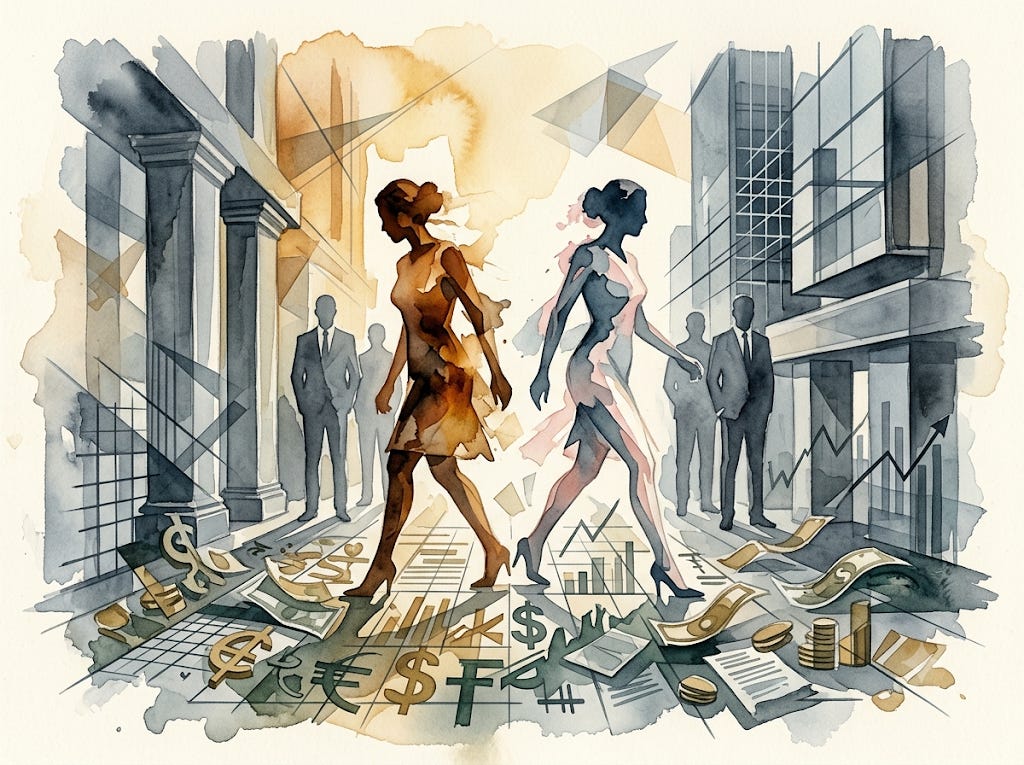
The exterior world does not rearrange itself simply because we have. Workplaces were not built with women’s agency in mind. Financial systems were not designed to facilitate our independence. The social dynamics between women and the men around them, and between women ourselves, are still being shaped by a paradigm that benefits most when we remain fragmented, financially dependent, and uncertain of our worth.
Part 2 asks: How do we navigate that?
How do you build a career and protect your ambitions inside a framework built for men? Why is financial independence plan A and not plan B if you don’t marry? What does it cost to exist as “other” in spaces that were never designed to hold you as you actually are? And what is the honest truth about how sovereignty shifts your relationships with other women, including the ones who are still negotiating their way through a system we’ve chosen to step outside of?
These are the questions that determine whether sovereignty remains a concept or becomes a way of life.
If you haven’t read Part 1 yet, start there. What we cover in this section will land with considerably more weight once you understand where each of us is coming from.
Part 2 of 3: Career, Money, and Otherness in Spaces Not Built for Sovereign Women
Career Pursuits in a Male Paradigm: How have you navigated your career and ambitions within a societal framework that is largely built for men?
Caroline: Growing up a tomboy, I have always had an unspoken toughness about me. I wasn’t a girl that would have been considered chatty or “sensitive” by 90s standards. In both middle school and high school, I played basketball a lot, often with boys and men. I inadvertently began to study the behaviors of males while playing with them on the basketball court. The one key thing I picked up on was when you say something to a man, you are giving him intel on who you are. He can then use that intel at his discretion at a later date. Subsequently, I learned to be very mindful of how and what I spoke about in the presence of men. One thing that men are good at is never showing their hand, particularly when it comes to what they talk about in the presence of women. Once I understood the power of strategic silence, I made it my mission to co-opt this characteristic.
What I came to understand is that strategic silence is not the same as staying small. There is a difference between the silence of a woman who has swallowed herself to avoid conflict and the silence of a woman who has decided that her plans belong to her and no one else. The latter is a form of personal sovereignty. What I had observed on the basketball court, I chose to bring into every professional space I entered. Not out of fear, but out of an understanding that the information you protect, you get to keep.
I adopted this motto: “It’s almost impossible for someone to ruin plans and dreams they don’t even know you have.” To this day, I move in silence and with stealth in the workplace. I carefully pick my battles, always using feminine intuition and foresight to weigh the pros and cons. I have to admit, psychologically, this mental disposition has had drawbacks through the years. While I used strategic silence as an invisible shield, at times people would take my silence as a license to try and push against my boundaries to gain leverage over me. It took time, but over the years I have learned to better pick and choose when it’s time to speak boldly and when it’s time to remain strategically silent.
Professionally, with healthcare in the US being comprised of 85% female workers, I have not really felt the need to defend my value and competence because of my gender. When I have had to interact with some of the men in upper management and leadership, I found that my reputation as a quiet, no nonsense kind of woman had preceded me in a positive way. My opinions were listened to respectfully and the encounters were never problematic for me professionally.
Ania: By nature, I am a career hopper. I have changed my path several times, and I must confess that my first professional choice was heavily shaped by societal expectations. I started my working life as a teacher. It’s the ultimate “great profession for a woman,” isn’t it? It is viewed as the perfect way to maintain a family life, be a mother and a wife, manage the household, and still earn some money. The moment I realized that, by choice, I did not want children or a traditional marriage, I made my first conscious career pivot to the business optimization area. When I joined my team, I was the only woman, and I remained the only one for several years. That was where I experienced the wage gap firsthand, earning less than the men who were doing the exact same work. I saw how differently career development is nurtured depending on your gender, and how even the language used in the workplace is subtly tailored to either grant or withhold professional support. When you navigate a professional framework built largely for men, you quickly learn that extreme competence is your most effective armor. I became the woman who could handle anything, fix any problem, and seamlessly navigate difficult rooms without ever dropping the ball. It worked beautifully to open doors and build my credibility, but it also created a trap. Without realizing it, my sense of security became largely dependent on my continuous usefulness and productivity. I was over-functioning to make myself so indispensable that my presence in those spaces could not be questioned. It was a highly successful adaptation to the environment, but it eventually cost me my ability to rest and rely on my inner compass. Today, I am incredibly grateful for the fierce competence that built my foundation, but I no longer ask it to carry the weight of my safety. Recognizing this trap and actually changing it did not happen overnight. And to be completely frank, I am not sure if my ability to finally immerse myself in my true nature is entirely separate from the agency I trained myself to have during all those years. It is a bit of a chicken-and-egg situation. My current feminine confidence and sovereignty are likely possible exactly because of those experiences, even the bitter ones.
The Role of Money: Why is financial independence such a non-negotiable foundation for feminine sovereignty?
Caroline: As an adult woman, financial autonomy gives you options, and options help minimize the trappings laid for women within patriarchy namely reproductive, economic, and psychological coercion. Ideally, a girl with the proper guidance from her mother during childhood would have built a foundation of health, self-knowledge, consciousness, and wisdom by the time she becomes an adult woman. But, we as women know all too well that many of our foremothers were compromised, due to no fault of their own, by the patriarchal restrictions they experienced in their day-to-day lives. They simply were in no position to teach us about feminine sovereignty when they didn’t even have a tangible concept for it themselves.
Hell, there are still women online today, both old and young, arguing that they don’t need the rights that feminism helped them gain because they have a husband and they’ve put all their faith and trust in him. Women like this undoubtedly were raised by mothers that could not offer them woman-centered guidance so they don’t understand why having your own money is so important. They were never given a woman-centered perspective on health, knowledge, consciousness, and wisdom, the foundation that precedes financial sovereignty. The lack of this woman-centered understanding creates male-centered women who only see the world through a male lens.
In a male-centered woman’s eyes, being a capable, financially sovereign woman is “masculine” and will lessen her desirability to men. But as one popular TikToker said a few years back, “A man is not a plan.” Money is a non-negotiable for any woman seeking feminine sovereignty because the patriarchal paradigm we live in is not built on values or virtue. It is built on the control of resources, and money is the primary vehicle of that control.
So what does this really mean for women?
It means human rights are not bestowed at birth, they are earned through the control of money and assets. It’s no coincidence that the poorest people on earth are always the most maligned and disenfranchised. Couple that with being female, and the lack of money causes you to marry younger than you should, have more children than you desire, and accept limited opportunities for education leading to lower literacy rates and diminished critical thinking capacity.
Coverture laws codified women as property. Today, economic nonviability does the same. It may not be fair or ethical, but women have to financially earn the right to own and control their bodies along with earning every other autonomous decision we desire to make. I am a person, not a piece of property. So, I do what I must to maintain my personhood and feminine sovereignty.
Ania: Let me start with a simple and harsh truth: a woman cannot be fully sovereign without financial independence. Financial independence provides a specific kind of leverage that simply cannot be substituted by any other resource. When you have no financial ground to stand on, you also lack the ability to choose freely. Every aspect of your life—your path, your next move, your deepest needs, your choice of partner, your job, and even your sense of self—becomes compromised. Financial stability gives you the ultimate luxury: the ability to simply say “no.” You can decline a bad offer, walk away from a draining relationship, or reject an unfair demand simply because you have the financial option to do so. Without that safety net, those options disappear. You lose your agency, and other people get to decide what you can and cannot do. If acknowledging this makes me sound materialistic, I will gladly accept the label. I am definitely not on “team money doesn’t matter.” However, hoarding money is not the ultimate goal of my life, either. Instead, I view financial independence like a body’s circulatory system or a city’s fundamental infrastructure. It is not the meaning of life, but it makes life possible. It is the invisible framework that allows you to make choices and set firm boundaries. It is the required capital to take a risk, to leave a room, to voice a disagreement, and to initiate a profound change. But what is equally important to me is how we use that money and what we do once we achieve that independence. For me, the ultimate expression of feminine sovereignty is keeping that money in motion. It is about using our financial ground to support other women, to invest in our local neighborhoods, and to ensure that resources circulate freely. Money comes in, and it moves forward. We build our own stability not just to build a fortress, but to water the ground around us and help others climb the staircase, too.
Recognizing "Otherness": How did you come to accept your inherent "otherness"—whether through introversion or simply existing as a woman in a male-centered world?
Caroline: As a neurodivergent, introverted Black woman who was never traditionally feminine, it was very difficult at times for me to navigate through the intersectional layers that were the makings of my identity. One of the first hurdles I faced growing up in a southern, predominantly Christian state in America were men and boys, and sometimes women, demanding that I perform traditional femininity. During adolescence, it was clear to all on-lookers that I hated dresses, skirts, and make-up so I was often labeled as “masculine”. Many attempts were made socially to “revoke” my female status as a way to punish my nonconformity. My tomboyish mannerisms coupled with neurodivergent introvertedness caused people to misunderstand me which led to ill-thoughts about my intentions.
What I hadn’t fully reckoned with was that I had been carrying all of that weight straight into pharmacy school. The years of being misread, the exhaustion of navigating others’ projections, the constant effort of existing in spaces that weren’t built for someone like me. By my fourth year of clinical rotations I was running on fumes. Three years of giving everything I had psychologically had left me depleted, and that depletion was telling a story I hadn’t consciously chosen to tell. I wasn’t speaking my frustration aloud, but my reactions and my nonverbal cues were being read by someone paying close enough attention to notice.
That someone was a preceptor I had in my 4th year, who herself was a neurodivergent introvert. Her feedback on my assignments had felt harsh and, unbeknownst to me at the time, she had picked up on my feelings about it. A few days later, she offered me counsel I wasn’t expecting. She explained that our difficulties often stem from others perceiving us as “cold” and “rude”. I myself had thought she was a bit too harsh and stoic so this really gave me pause leading to deep self-reflection. Her identifying with me as a fellow neurodivergent introvert created an opening and I confided in her about what I had been feeling. To my surprise, she softened in that moment in almost a motherly way. Having a fellow neurodivergent introvert hold up a proverbial mirror for me in that conversation really helped me become a better communicator.
I believe the first thing every sovereign woman must do is tell her own story. She has to get comfortable with speaking her own truth. If she doesn’t, the outside world will attempt to decide that truth for her. Receiving this feedback just as I was about to start my career as a pharmacist helped me convey to others my lived principles, expectations for my interpersonal relationships, and my personal boundaries. Once I figured out how to speak these truths about who I was as a woman, the tension I always felt in the air when interacting with others began to dissipate. People began to realize that if they chose to think something other than what I had explicitly stated as my truth, then they were the one who would carry that emotional baggage, not me. Speaking my truth has always psychologically unburdened me, making room for self-acceptance. As I continued developing my communications skills, I was able to settle into my identity as a neurodivergent introverted woman.
Ania: To answer this honestly, I have to admit that accepting my “otherness” was not some beautiful, linear awakening. As introverted women, we rarely talk about this bluntly, but the truth is a bit harsh. Every one of us eventually discovers that being fully ourselves often means being underestimated, misunderstood, overlooked, or even rejected. For a long time, my difference felt like a psychological prison. I experienced a very specific kind of friction with the world. From other women, I often felt the underlying message that I wasn’t “woman enough” to be their friend—I lacked that spontaneous energy and the ability to make easy small talk. Men, on the other hand, were often confused by me. I didn’t need to be saved, assisted, or helped, which left them without a traditional role to play around me. Add my boldness in simply being myself, and their confusion was guaranteed. The actual process of coming to terms with my own nature only began the moment I stopped feeling uncomfortable about what others thought of me. That one decision shifted the entire foundation I had built my life upon. My environment still placed expectations on me, but my validation stopped coming from the outside. Today, when I trust myself and show my true nature without a mask, is it easier? Yes and no. It turns out that only by not artificially dimming my light can I attract the right people. Those who actually understand both my feminine and masculine sides. But it also means that accepting my “otherness” is not a one-time achievement. It is a constant, daily choice to choose myself. It is a daily practice of finding that reference point within and trusting my own decisions even when some of the consequences might hurt.
Relationships with Other Women: How has reclaiming your sovereignty shifted your dynamics with other women, particularly those who are still operating from a male-centered perspective?
Caroline: To be completely honest, reclaiming my sovereignty as a woman has somewhat alienated me from women, particularly other “elder” millennials (those born in the 80s). As I shifted from male-centered thinking to woman-centered thinking, I found I had less and less in common with my female peers. With me being a neurodivergent introvert, there was always a gap in commonality between me and other women. When I embarked on my journey of feminine sovereignty, I discovered that many women simply weren’t interested in this type of feminine power. Many women were and are still seeking power through proximity to the right type of man. It became apparent to me that even most women who were self-proclaimed feminists really just wanted men to change without having to put forth the effort to change anything about themselves.
Admittedly, it was deflating to watch so many women latch on to “soft life” and “trad wife” propaganda when it first started becoming popular on social media a few years back. The online explosion of that content shined a light on the fact that many women do not want the responsibility of maintaining feminine sovereignty. I can remember sharing a few sovereign principles in the comments section of a fellow sovereign woman’s TikTok and the response to my comment was “my take was too masculine”. My comment simply highlighted how accepting personal responsibility for your life as a woman is the ultimate form of self-protection within a patriarchal world. I stewed over this response for days. Ultimately, it forced me to accept that many women just want to broker a better deal within the system of patriarchy. They aren’t really interested in designing a life built on woman-centered principles which would allow them to escape the confines of it. I’ve made my peace with that. The path of sovereignty is not one every woman is ready for, and I no longer need it to be.
What that acceptance freed me to do was redirect my energy toward the women who are actively becoming architects of their own lives. For most of my sovereign journey, I had been a tribe of one. As I continued to speak my truth and share woman-centered principles, I began finding like-minded women. Women who were done negotiating with a system designed to keep them small and had chosen instead to build their lives entirely on their own terms. Ania is one of those women. The fact that we are co-authoring this very series together is proof that the tribe was never as small as my years of isolation made it feel.
Ania: I would say the answer is both yes and no. As a young woman, I often felt an underlying message from other women that I simply wasn’t “woman enough” to be their friend. Because of my introverted “otherness”, I lacked that spontaneous energy and the ability to make easy small talk. Making seamless, effortless connections just wasn’t my gift. On top of that, before I fully realized and embraced that my path would be child-free and non-traditional, I felt a deep disconnect. I knew I didn’t belong in groups of women who centered their lives around traditional milestones, yet I still deeply craved that fundamental feeling of belonging. Paradoxically, the real shift happened only when I fully accepted my own “otherness”. Once I became consciously aware of why and how I trigger other people, including other women, my relationships with them actually became much better and richer. I stopped taking their discomfort personally. Midlife has profoundly deepened my appreciation for women as a whole, regardless of the paths they choose to walk each day. My introverted awkwardness hasn’t magically disappeared. I still don’t form new relationships with women easily or quickly. However, I am at a stage in life where my genuine curiosity about different perspectives, choices, and decisions is far more important to me than the differences that separate us. I suspect this shift is the direct result of finally moving my validation inward. The judgment of others simply no longer holds power over me. Or perhaps it is even simpler than that: living life entirely on my own terms has given me the security and openness to respect how others choose to live theirs, even if they are still operating within a male-centered framework.
Navigation means you’re still moving through something.
And at some point the core question shifts.
You’re no longer asking, “how do I get through this?” but “what does it look like on the other side?”
What does sovereignty feel like on an ordinary day, not as a concept but as a lived reality? What did it cost to build? What did it free? How do you define womanhood once you’ve stripped away everything the patriarchal world insisted it had to be?
Part 3 is where we answer that, including the question we get asked most: if you know you need to start this work, but fear has you paralyzed, how exactly do you begin?
Mine truly,
Caroline
The Rogue Night Pharmacist